


We give you the basic knowledge you need to help in the selection of your freezer.
The basic principle behind a freezer is evaporation. When a liquid evaporates it causes the surrounding area to cool. For example, on a hot summer's day if you sprinkle water on your skin it will cool your skin as the water evaporatess. That's an example of refrigeration!
Water can't be used in freezer though, because it evaporates at too high a temperature. But some liquids evaporate at very low temperatures. For example Isobutane (becoming more common in domestic freezers) evaporates at very low temperatures. This ability to evaporate at very low temperatures means that it cools surfaces which are already very cold.
Evaporation is affected by air pressure. The higher the air pressure, the less a liquid will evaporate.
1. The Compressor takes in the refrigerant (as gas), raises the air pressure which converts the refrigerant gas to liquid (compressor and light pink in diagram below).
2. As the refrigerant liquid flows from the Compressor to the Expansion Valve the high air pressure stops it evaporating and instead it gives off heat and becomes cooler.
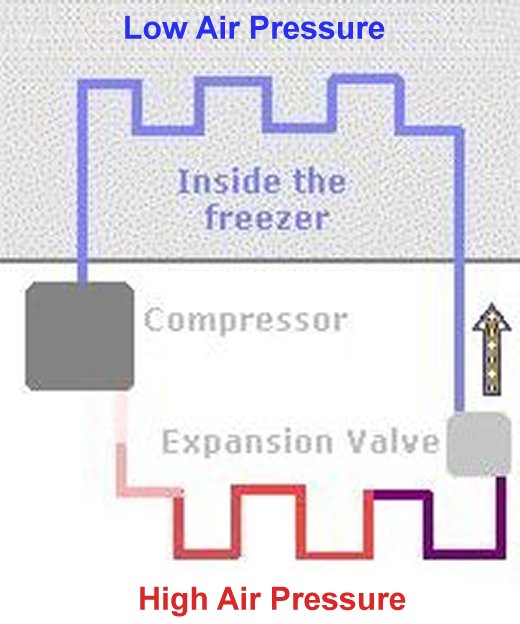

Diagram of how a freezer works
3. The refrigerant liquid flows through the expansion valve (into the blue pipe) where the air pressure is much lower. This causes the refrigerant liquid to evaporate which cause the pipe to become very cold inside the freezer.
4. One key component of the freezer is missing from the diagram, the thermostat. The thermostat senses the temperature inside the freezer and when it drops below a certain temperature it turns off the motor so the flow of the refrigerant liquid stops. When the temperature rises above a certain level the thermostat turns on the motor and the refrigeration process restarts.
REFRIGERANT LIQUIDS
Different freezers have different refrigerant liquids. Which liquid is
used is important for two main reasons. Firstly different liquids
are more or less efficient for use in a freezer. Less efficient liquids
will use more electricity and therefore cost you more to run your freezer.
Secondly, some refrigerant liquids contribute significantly more than others to global warming and destruction of the ozone layer. Pre-1990 many freezers used CFC which caused significant environmental damage to the atmosphere. This was then replaced with MFC which does not destroy the ozone layer but still does contribute to global warming. Currently HC and Isobutane are used as refrigerant liquids in most domestic freezers. Both are a great improvement with Isobutane being the best.